

Toxic Objects - Thought-Provoking
Sculptures in public spaces have a turbulent history. Some of them are preserved here in the Bastion Königin at Zitadelle Spandau. How should we handle toxic objects? Show them? Contextualize? Intervene?
In 2024, students of the Bachelor’s program in Museum Studies at HTW Berlin University of Applied Science spent a semester exploring these questions. The process of their negotiations is documented in a video installation and is presented here in dialog with the objects.
We invite you to form your own opinion about these Toxic Objects.
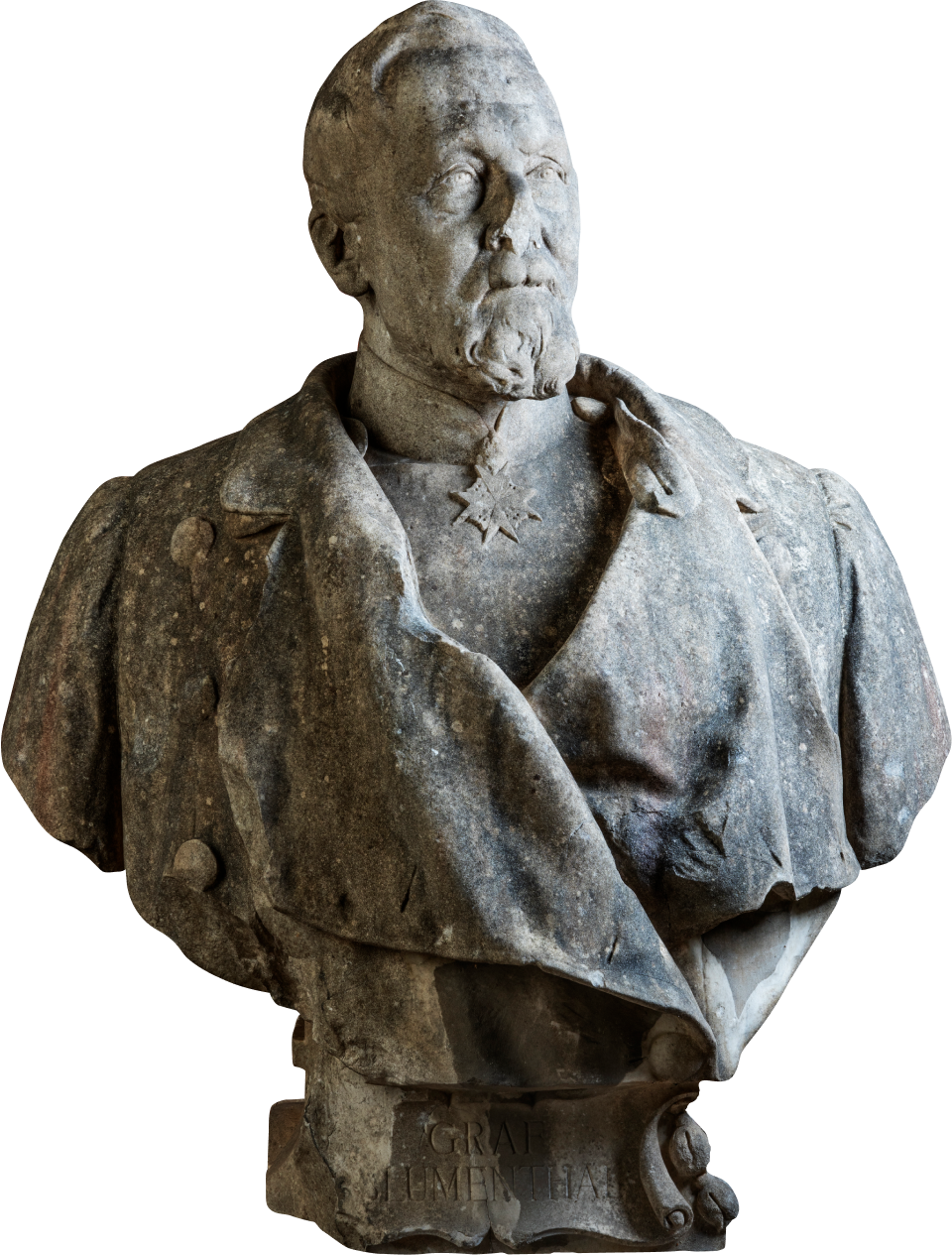
Bust “Count Leonhard von Blumenthal”
Adolf Brütt (1855 – 1939)
Unveiling: 1903
Marble
The Prussian Field Marshal General Count Leonhard von Blumenthal is depicted. He was elevated to the nobility for his military-strategic achievements. Together with the
portraits of King Friedrich III and the physician Hermann von Helmholtz, this bust forms group 33 of the Siegesallee (Victory Avenue). It represents Prussia’s claims to power.
From Sword Dance to Siegesallee
Based on a design by Ernst von Ihne, Brütt created Group 33 on Siegesallee, which served as a link to his 1904 statue of Prince Wilhelm of Prussia and the relief of the Kaiser Wilhelm Memorial Church in Berlin, completed in Weimar in 1906. The sculptor achieved worldwide fame with “Die Schwerttänzerin” (The Female Sword Dancer, 1891-1893). He received the gold medal for this work at the World Exhibition in Paris in 1900. As the main representative of North German realism, he held a professorship and a senatorial position at the Prussian Academy of Arts in Berlin.
You can find out more about Siegesallee in the exhibition “Unveiled – Berlin and its monuments”.
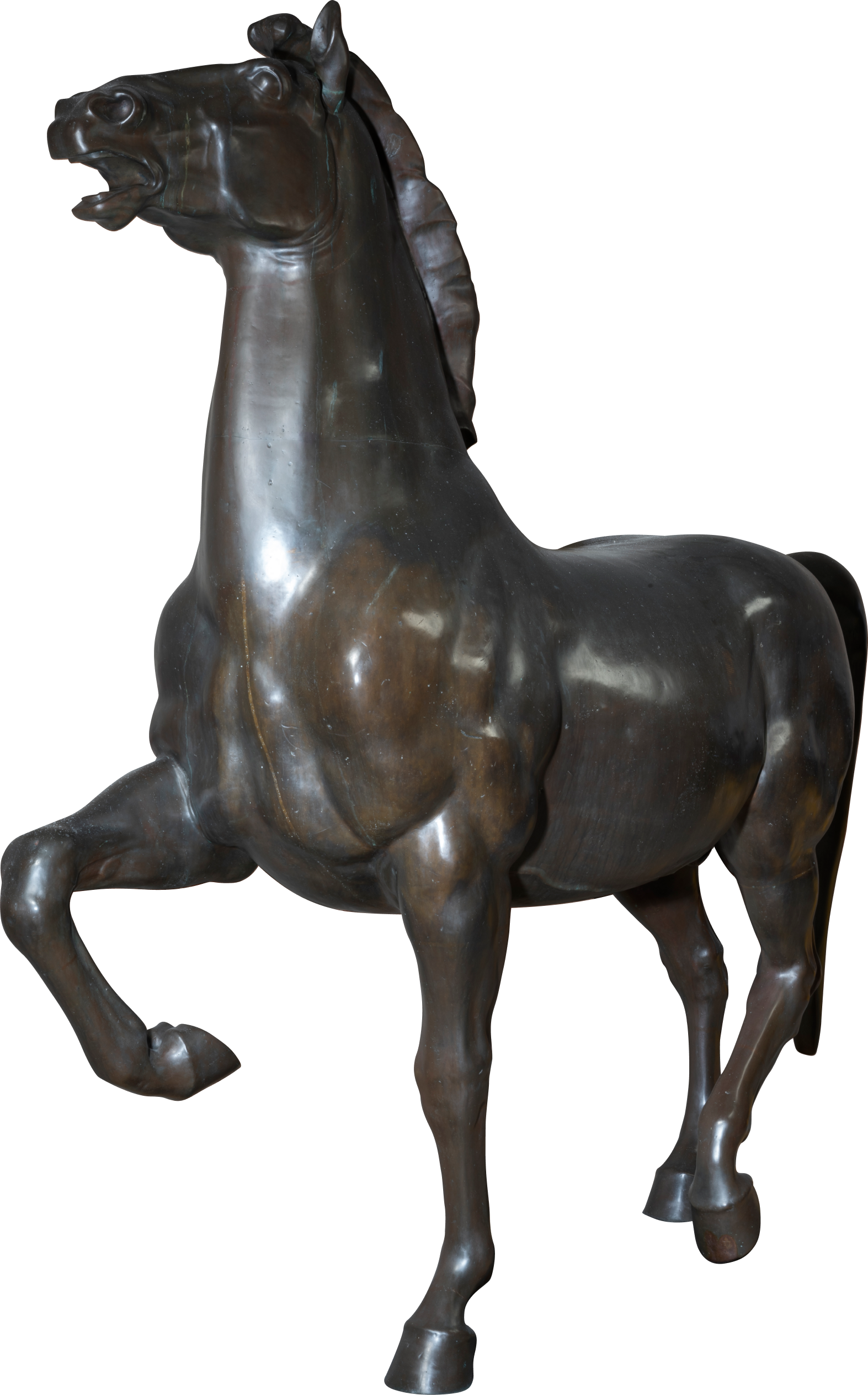
One figure of the sculpture “Schreitende Pferde” (Striding Horses)
Josef Thorak (1889-1952)
Created: 1939
Bronze
This figure was originally part of the statue “Schreitende Pferde”, which Thorak gifted to Adolf Hitler in 1939. Who had it erected in front of the New Reich Chancellery. Thorak maintained close relationships with Adolf Hitler, Joseph Goebbels and Albert Speer, which helped him to obtain lucrative commissioned work during the Nazi era and to be included in the Gottbegnadeten Liste – a list of artists worthy of protection compiled in order of Goebbels in 1944. Those were exempted from frontline service in the Second World War.
The Myth of Innocence
After the war, Thorak successfully portrayed himself as an innocent artist. In reality, he was involved in the Nazi art theft, had a state-funded studio built for himself by Albert Speer and illegally arranged for the sale of Schloss Prielau at Lake Chiemsee by the Gauleitung Salzburg. For his own exhibition, he made a third horse, which was donated by his family to the Landschulheim Ising am See in 1961 – as compensation for a relative’s boarding school fee. The sculpture still stands there today, uncommented, with Thorak’s signature on the plinth.
You can find out more about Schreitende Pferde in the exhibition “Unveiled – Berlin and its monuments”.
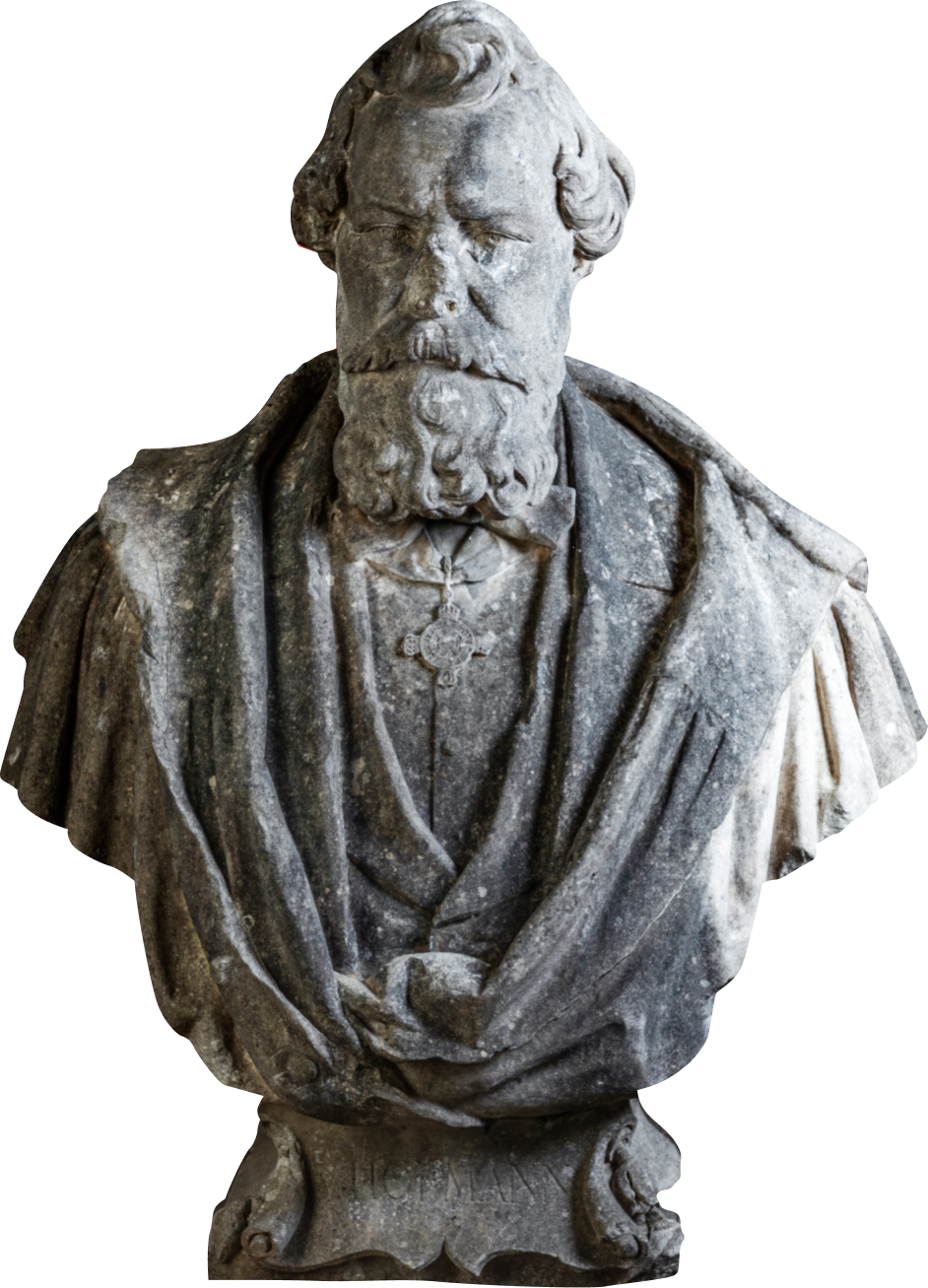
Bust of “Anton Wilhelm Hofmann”
Fritz Gerth (1845 – 1928)
Unveiling: October 18, 1903
Marble
The bust depicts the chemist Anton Wilhelm Hofmann. He was head of the College of Chemistry in London for many years and rector of the Friedrich Wilhelm University in Berlin. His bust, together with one of philosopher and theologian Eduard Zeller and the statue of the “Empress Friedrich”, is part of Group 34 of “Siegesallee” (Victory Avenue).
Power, Marble, Masculinity
The „Siegesallee“ stood in the eastern part of Berlin’s Tiergarten from 1898 until it was dismantled by the Allies in 1954. It was donated to the city of Berlin by Kaiser Wilhelm II as an ornament of honor. Its aim was to show Brandenburg-Prussia’s part in the founding of the German Empire and the social spectrum of the past 750 years. For this purpose, male statues, which were considered representative, were carved in marble. The only female person depicted was Queen Victoria of Great Britain and
Ireland, known as “Empress Frederich”. Her group and the one of her husband, Emperor Frederich III, were added to the existing 32 groups in 1903.
You can find out more about Siegesallee in the exhibition “Unveiled – Berlin and its monuments”.
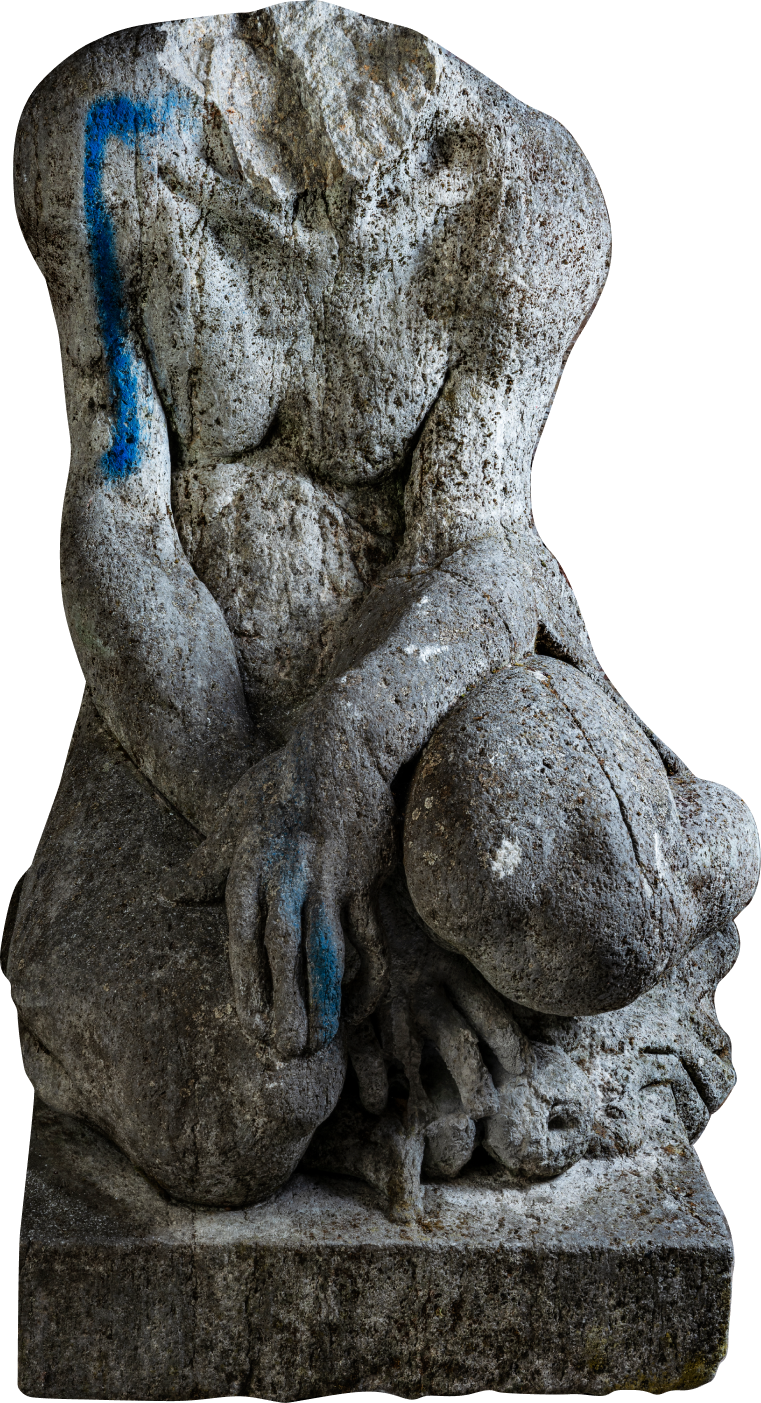
Sculpture: “Die Hockende” (The Kneeling Figure)
Arminius Hasemann (1888-1979)
Created: presumably 1920s
Shell limestone
What does the condition of this sculpture evoke in you?
In 1980, Hasemann’s former studio and home in Berlin-Zehlendorf was demolished. Five years later, through the commitment of influential neighbors, two of his works were erected on the green verge opposite this property. The sculpture shown here and that of a standing faun were intended to honor the artist’s memory.
Controversy in Public Space
The inscription on the statue, which was added in 2000 by the Zehlendorf local history association and financed by donations, bore a clearly racist title that was not given by the artist. On June 17, 2020, the head of the statue was chopped off by unknown people, whereupon it was taken down and received public attention for the first time. A debate broke out about the racist depiction of a Black woman by the National Socialist artist Arminius Hasemann, who was already a member of the NSDAP before 1933 and later concealed his work from 1932 to 1945 on several occasions
The racist title is not reproduced in this exhibition.
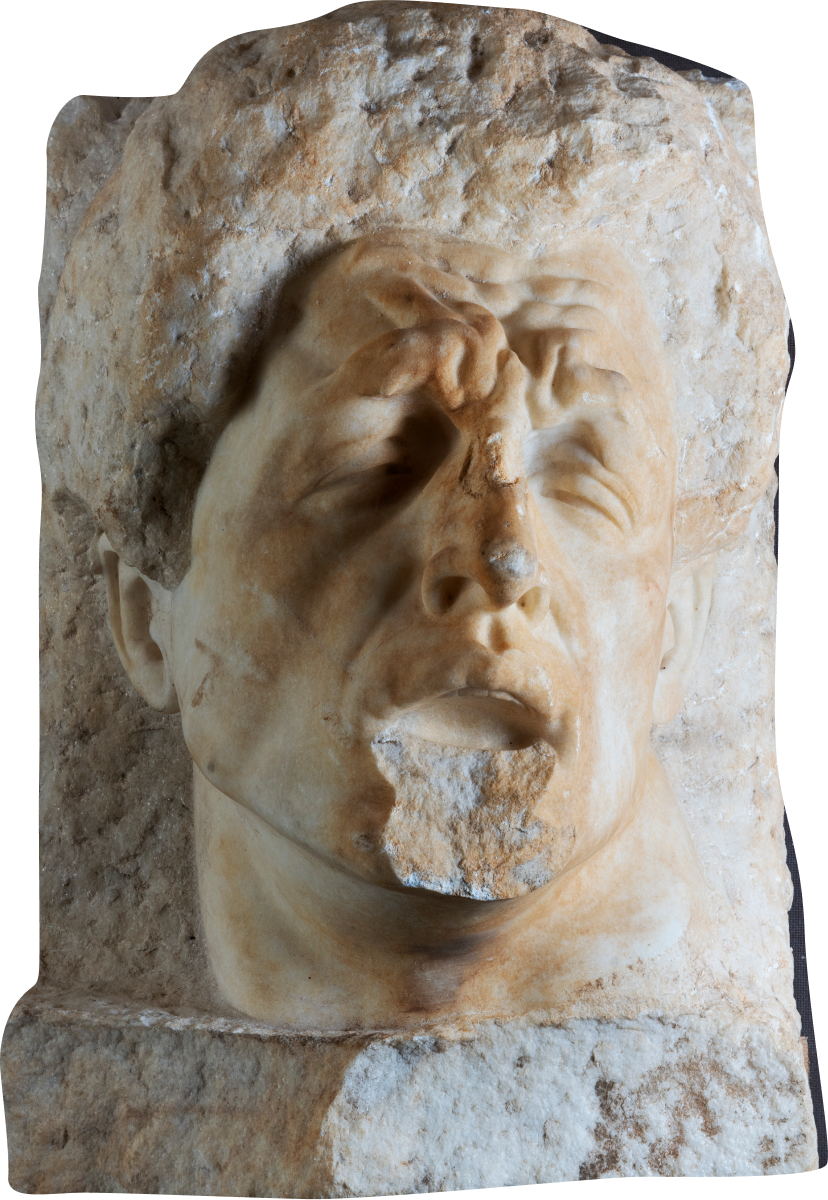
Head Sculpture “Romanichel”
Atelier of Arno Breker
Created: approx. 1940
Marble
The sculpture depicts a male Romani person. Breker met him in Paris in the 1920s and portrayed him multiple times. This sculpture was executed using the non-finito technique and shows signs of damage. It is not attributed to Breker himself, but originates from his atelier.
Hitler’s Sculptor
Arno Breker (1900-1991) spent the 1920s in Paris. His early works reflected a modern style. After Adolf Hitler came to power, Breker returned to Germany. He participated in the competition for the design of the Olympic grounds and won second place for his bronze sculptures “Zehnkämpfer” (Male Decathlete) and “Siegerin” (Female Winner). Breker adapted to the aesthetics of the Nazi regime and contributed to its propaganda through art. From 1938 to 1945, he worked closely with Albert Speer on the planned expansion of the world capital Germania. At Adolf Hitler’s request, he created monumental sculptures and reliefs. Breker benefited both financially and in terms of prestige from these commissions and was included on the Gottbegnadeten-Liste (List of Divinely Gifted Artists). After the war, he was classified as a Mitläufer (follower). He continued working as a respected sculptor.
You can find out more about Zehnkämpfer in the exhibition “Unveiled – Berlin and its monuments”.
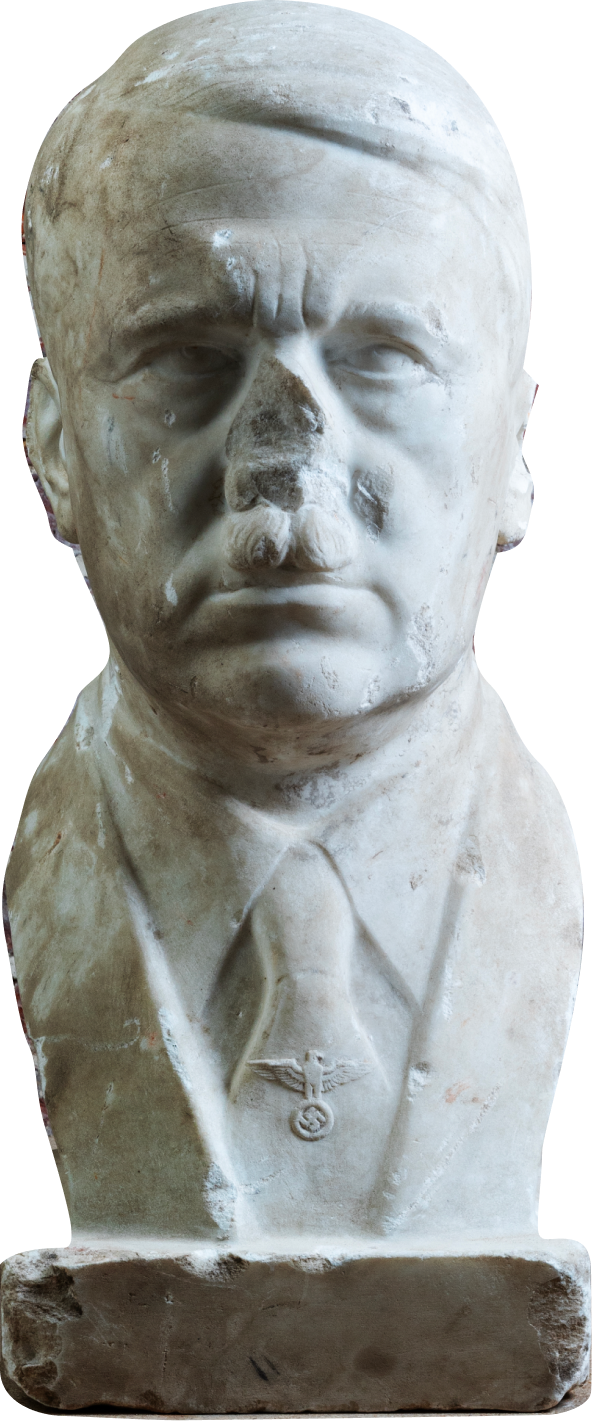
Portrait Bust “A.H.“
Josef Limburg (1874 – 1955)
Created: approx. 1937
Marble
What emotions does this bust evoke in you?
This bust glorifies the tyrant and dictator Adolf Hitler. It was found in a construction pit in Berlin. A public Nazi government building was located at this site until 1945. The bust may have been part of the building’s interior, or it may have ended up at the site by chance.
A tormenting choice – Did Josef Limburg create this bust because the time demanded it?
The son of a goldsmith, Limburg took over his father’s trade and studied fine arts. His acquaintance with the director of the Vatican Library brought him commissions for portraits of ecclesiastical dignitaries, including a colossal bust of Pope Gregory XIII. From that point on, his work was dominated by religious themes such as angels, Madonna figures and depictions of Christ.
After the National Socialists came to power, he changed his subjects in favor of portrayals of Adolf Hitler.